The Horizon Is Not a Line on the Ground
Understand the horizon by separating the geometric horizon from nearby ridges and haze, so each view tells you what is land, obstruction or open sky.
The common mistake is to call the nearest dark ridge “the horizon”. It can hide the farther view, leaving you with an apparent boundary rather than the geometric horizon. To read a horizon clearly, first distinguish the edge created by Earth’s curved surface from landforms and other objects that block your sightline.
Two kinds of boundary
The geometric horizon is the distant limit at which Earth’s curved surface would remain visible from your viewpoint, if no nearer obstruction or atmospheric effect got in the way. On open water, it is often easiest to recognise as the far boundary of the visible surface.
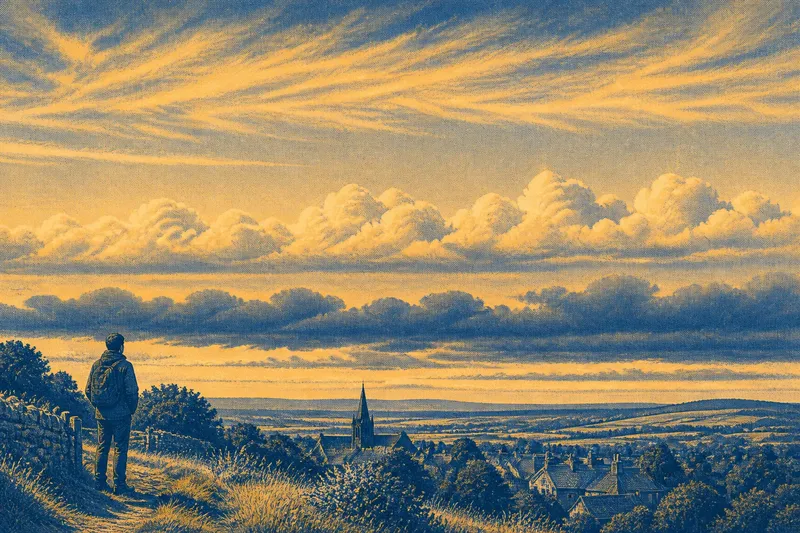
A ridge, tree line or roof can create a different kind of edge: the visible boundary between land and sky in that direction. It may look like the horizon, but it is an obstruction in the foreground or middle distance. The geometric horizon may lie beyond it, hidden from view.
In everyday speech, people often call the apparent land-sky boundary “the horizon”. That usage is understandable, but it can blur the distinction. When observing, ask whether you mean the geometric horizon or the nearest visible edge that resembles one.
Find an open view
Choose a safe place with a broad view, such as a beach, an open field or a public lookout. No compass or telescope is needed. Note anything close by—a wall, hedge, slope or row of buildings—that could block your line of sight.
Look beyond the nearest edge. On level, open ground, the geometric horizon may be faint or hard to separate from the sky. From a hill, you may see land across a valley before its distant edge approaches the sky. A visible ridge still marks the shape of the land, not necessarily the geometric horizon.
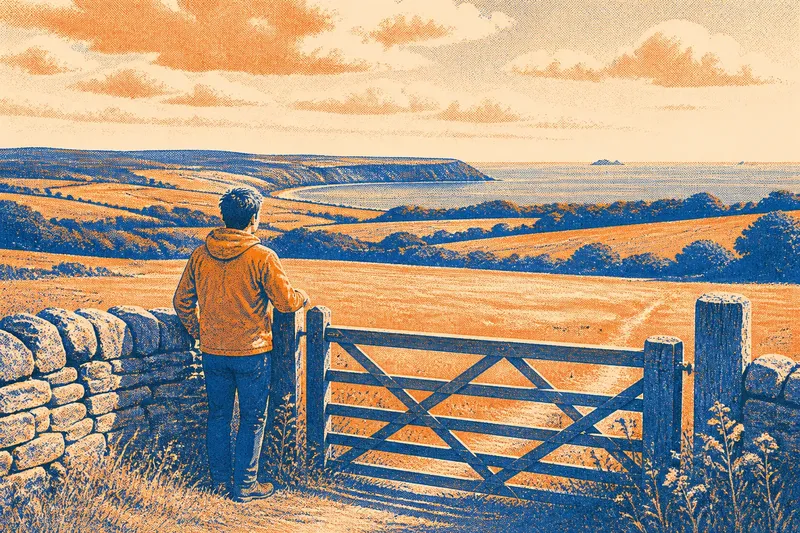
Try this invented situation: say you stand beside a low stone wall in a field and see the wall’s top against the sky. You move to an open gate, where the wall no longer blocks your view. The observable result is more of the field and its distant features; the wall remains a nearby obstruction, while the farther boundary may now be easier to identify.
Compare sightlines
Pick a nearby landmark and a more distant one, such as a hedge and a ridge. Shift your gaze between them. Nearby objects take up more of your view and conceal what lies behind them; the geometric horizon is farther away, where Earth’s surface curves out of sight.
Move to another safe spot and look in roughly the same direction. A tree that seemed to touch the sky may now sit against a hillside, while a gap reveals more distant land. The landscape has not rearranged itself; your changed position has altered which parts of it your sightline can reach.
- Check whether a wall or hedge fills the lower view; if it does, move to a safe open position, or use its top only as a nearby reference.
- Check whether the apparent edge has a recognisable slope or tree line; if it does, treat it as a landform, or look for a farther opening beyond it.
- Check whether a broad surface such as water remains visible to a distant boundary; if it does, use that edge as a clearer candidate for the geometric horizon, or note that the view is interrupted.
- Check whether haze merges distant land and sky; if it does, record the boundary as uncertain, or return when visibility improves.
- Check whether a cloud overlaps the apparent edge; if it does, treat the cloud as an atmospheric feature that may conceal the boundary, or observe a clear section of the view.
- Check whether a second viewpoint reveals land beyond the first edge; if it does, mark the first edge as an obstruction, or keep the horizon’s location unresolved if nothing farther is visible.
Height and distance
Viewpoint height changes how much surface you can see and how distant the geometric horizon appears. From low ground, slopes and buildings can screen the view. From a safe rise, you may see over some obstacles and recognise more of the surface beyond them.
Compare a level path with a nearby rise, keeping roughly the same direction. Notice which landmarks disappear behind foreground ground and which become visible. The visible edge is not a mark on the ground in front of you; it depends on sightline, surface shape and viewing height.
Open water can make the geometric horizon easier to distinguish because fewer nearby objects interrupt the view. Even there, the coast, distant islands, boats and atmospheric haze can complicate what you see. A clean-looking line is not always the geometric horizon if land or haze is defining the edge instead.
Land, haze and light
Haze, mist, cloud and low light can soften the boundary until it looks like a broad band. A dark ridge against a bright sky may seem crisp, but its sharp outline does not show that it is the farthest visible surface. Look for slopes, trees or other signs that the edge belongs to land.
A hazy band may blur several distant features together. Clouds belong to the sky; if they overlap the apparent edge, they may conceal the surface boundary rather than define it. Low sun can brighten haze or darken a ridge, while overcast light can flatten colour differences.
Revisit the same view under different light and note what becomes clearer or less distinct. If the edge changes in appearance, that alone does not mean the land has moved. Visibility and contrast may have changed instead.
Why does the horizon shift?
Is the geometric horizon always visible?
No. Hills, buildings, trees and haze can obscure it, and a confined view may show only nearby surfaces. You can identify what blocks the sightline even when the geometric horizon itself is hidden.
Why does the horizon look different from a hill?
A higher viewpoint lets you see over some nearby ground and obstacles. The geometric horizon appears farther away, while more of the surrounding surface may enter view.
Is a mountain ridge the horizon?
In everyday speech, a ridge can be called the horizon because it forms the visible land-sky boundary. More precisely, it is an obstruction; the geometric horizon lies beyond it if the curved surface is visible in that direction.
Does the horizon move during the day?
Changing light can make a boundary appear sharper, softer or differently coloured. Clouds and haze also affect visibility, so a changed appearance does not necessarily mean the land’s outline has shifted.
Record what you see
At your chosen spot, note the nearest obstruction, the clearest distant landmark and the direction in which the visible surface seems to disappear. Sketch the foreground below and sky above. Draw the apparent boundary lightly, then mark any ridge, building or haze that might be hiding the geometric horizon.
Make a second sketch from a nearby position and compare them. If a feature that seemed to meet the sky now sits against more distant land, the first edge was likely an obstruction. If haze still hides the distant surface, leave the geometric horizon’s position uncertain rather than forcing a precise line.
The useful question is not simply “Where is the horizon?” but “Which boundary am I looking at?” That distinction makes the horizon easier to interpret: a ridge can mark the visible edge of land, while the geometric horizon is the farther limit set by Earth’s curve and your viewpoint.