Moon Phase Names: What Crescent, Gibbous and Quarter Mean
Understand Moon phase names by separating the Moon’s visible shape from its direction of change, so your sky notes describe what you actually see.
The common mistake with Moon phase names is to assume that “quarter” means a quarter-lit disc. It does not, and that confusion can turn a quick glance at the Moon into a vocabulary puzzle. Moon phase names describe either the visible shape or how that shape is changing.
Look at the bright part first. Is less than half the disc lit, or more than half? Then ask whether the lit portion is growing or shrinking. Those observations give you the everyday terms without a chart or telescope.
Shape and change
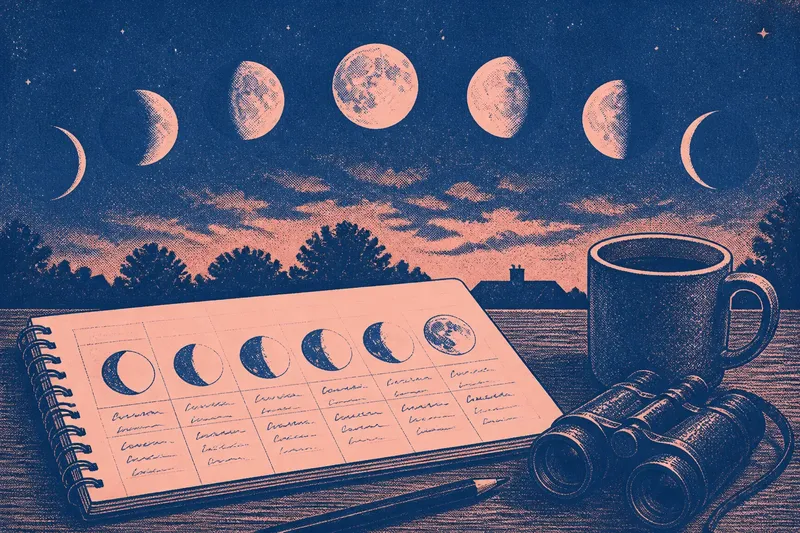
A crescent has less than half of its visible disc illuminated. A gibbous Moon has more than half illuminated but is not full. “Waxing” means the visible lit portion is increasing; “waning” means it is decreasing. Shape and direction are separate clues: a Moon can be a waxing crescent or a waning crescent, for instance.
The familiar sequence runs from new Moon through waxing crescent, first quarter and waxing gibbous to full Moon, then through waning gibbous, last quarter and waning crescent. These are useful names for parts of a continuous cycle, not eight sharply divided shapes.
- New Moon: the Moon is near the Sun’s direction in the sky, and its sunlit side faces mostly away from Earth.
- Crescent: less than half of the visible disc is lit.
- Quarter: about half of the visible disc is lit.
- Gibbous: more than half is lit, but the disc is not full.
- Full Moon: the visible face appears fully illuminated.
Why quarter means half
“First quarter” and “last quarter” refer to the Moon’s position in its phase cycle, not to the fraction of its visible face that is bright. At either quarter phase, we see about half the disc illuminated. The wording makes more sense when you think of the cycle’s progress rather than measuring the bright area.
Waxing and waning answer a different question. They tell you whether the visible lit portion is increasing or decreasing. A single glance may reveal the shape but leave the direction uncertain, especially if you have not watched the Moon recently.
How did the names develop?
The names work as a practical vocabulary for observing a repeating pattern. “Crescent” and “gibbous” describe the Moon’s outline; “waxing” and “waning” describe change; “quarter” marks a position in the cycle. Together they let observers compare what they see without suggesting that the Moon itself changes shape.
There is a limit to what these everyday English terms can tell you about their history. They explain how the names are used now, but they do not establish when each term first entered use or how different communities named the lunar cycle. Local languages and cultural calendars may organise or describe that cycle in other ways.
Reading a phase name?
What does “gibbous” mean?
Gibbous describes a Moon that looks more than half illuminated but is not full. The word points to its rounded, bulging appearance.
Can a quarter Moon be half lit?
Yes. “Quarter” names the Moon’s place in its cycle, while the visible disc appears about half illuminated.
How can I tell waxing from waning?
Compare the Moon with a later view, or check a reliable lunar calendar if you need the phase date. The bright edge’s orientation is not a universal shortcut, because its appearance depends on your location and viewpoint.
Do phase names work everywhere?
These English terms are common in sky guides, but other languages and cultural calendars may use different names or organise the lunar cycle differently. When sharing an observation, describe the visible shape as well as giving a phase label.
Notes from the sky
Keep observation separate from interpretation. Write down the date, approximate time, visible shape and position in the sky. Add “waxing” or “waning” only when you have a basis for judging the direction of change. A phone calendar can help with that comparison; your eyes supply the description.
Say you see a slim crescent from your back garden one evening, then a broader crescent from the same spot the next evening. Record the dates and the shape each night; the widening lit portion supports calling the Moon waxing. If clouds hide most of the disc on the second evening, note that uncertainty rather than treating a fleeting glimpse as a clear comparison.
- If the bright portion is less than half the disc, call the shape a crescent; if the edge is obscured, record the visible part without forcing a shape label.
- If more than half is lit but the disc is not full, call it gibbous; if haze makes the boundary unclear, describe the appearance as uncertain.
- If about half the disc is lit, call it a quarter Moon; if you cannot judge the fraction, write down the visible shape instead.
- If a later observation shows more of the disc lit, describe the Moon as waxing; if you lack a comparable view, leave the direction unstated or consult a lunar calendar.
- If a later observation shows less of the disc lit, describe it as waning; if clouds or a blocked view prevent comparison, note that limitation rather than guessing.
- If you need to share the observation, include the date, approximate time and direction; if you did not record one of those details, say so instead of filling it in from memory.
For your next look at the Moon, separate its visible shape from its direction of change. Moon phase names make that distinction compact, while a few plain words preserve the details that a label leaves out.