How to Sketch Clouds Before Rain Without Guessing
A cloud sketch before rain helps you record visible changes, compare the sky later and keep observation separate from a guess about the weather.
The common mistake in a cloud sketch before rain is to draw a dark patch and call it a warning. That can leave you with a confident guess but no clear record of what changed. Instead, note visible signs such as a spreading cloud edge, a narrowing bright gap or rain already falling nearby.
A pencil, scrap of paper and a view of the sky are enough. Keep the exercise focused on what you can see: how cloud cover changes, whether the light dims, and whether raindrops actually reach your location. A sketch cannot tell you what will happen next, so check a trusted local forecast when plans depend on the weather.
Choose useful details
Rain-related clues are observations, not promises. A cloud may look darker because the light has changed; a growing area of cloud may pass without rain reaching you. Record separate details rather than combining them into a prediction.
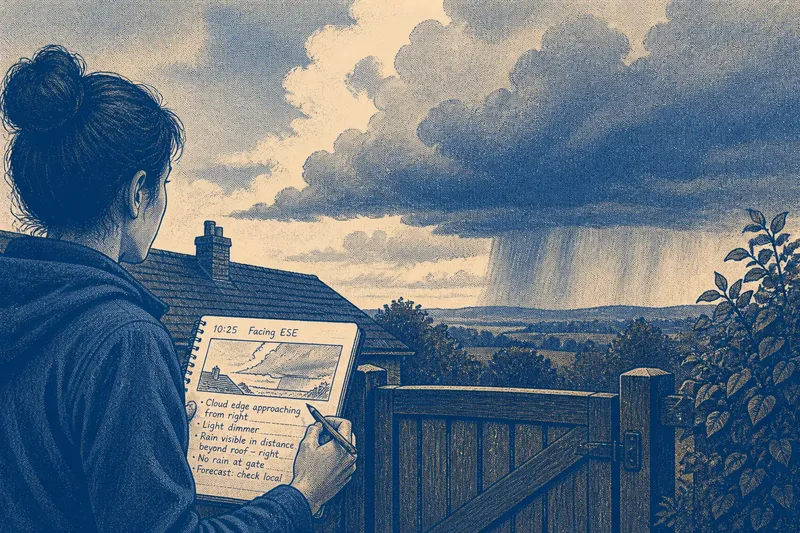
Use a small box for the part of the sky you can see. Add a roof edge, tree or hill as a landmark, then make a few loose shapes for the cloud cover. Leave gaps blank. They help you notice whether a clear patch narrows or widens.
Beside the sketch, note the time, the direction you face and a brief description of the light. If rain begins, write that down as a separate observation, including whether you can see drops at your location. Do not look at the Sun, and choose a safe place away from traffic.
Read rain clues carefully
Look for changes that relate directly to rain reaching your spot. A cloud edge approaching overhead is different from rain visible in the distance. If you can see rain falling beneath a cloud, record where it is in relation to your landmark; it may still miss your position.
Changing light can add context. Note “light dimmer” or “bright gap closing” rather than “storm coming”. If the cloud’s underside is hard to see, or buildings block the view, write “unclear”. An honest gap in the record is more useful than a forced interpretation.
Imagine you are standing by a garden gate with a roofline in view. You sketch a broad cloud approaching from the right and note that the light has dimmed; later, you see rain falling beyond the roof but not at the gate. Your record distinguishes approaching cloud, changing light and distant rain from rain at your own location.
Make each observation useful
For each item, record the observation and make the decision that follows. If the evidence is unclear, choose the alternative rather than filling in a guess.
- Cloud edge: Check whether it is approaching your landmark; if it is, note its direction and check a local forecast before making weather-dependent plans, but if its movement is unclear, write “unclear” and do not infer rain.
- Bright gap: Check whether the clear space is narrowing; if it is, note the change in light, but if the gap remains steady or is hard to see, record that instead of calling rain likely.
- Visible rainfall: Check whether drops are falling at your location or only in the distance; if they reach you, record rain here, but if they are distant, note their position and do not treat them as local rainfall.
- View obstruction: Check whether a tree, building or window reflection hides the sky; if it does, mark the blocked area and use another safe viewpoint if available, but if none is available, leave that part unjudged.
- Changing light: Check whether the scene looks dimmer than at your previous note; if it does, record “dimmer” separately from cloud shape, but if the light is similar or uncertain, do not use brightness as a rain prediction.
- Forecast: Check a trusted local weather service when an outdoor plan depends on rain; if it indicates a relevant risk, adjust the plan as appropriate, but if no forecast is available, avoid treating your sketch as a substitute.
Keep the record fair
Use the same landmark and roughly the same view when you look again. Add a fresh time note and draw what is there now; do not redraw the earlier sky from memory. A phone photo can support the notes, but changing zoom or framing can make comparisons less clear.
Cloud shape, brightness and rainfall are different observations. Keep them in separate words or marks. “Cloud edge nearer the roof” describes position; “light dimmer” describes appearance; “rain at the gate” describes what reached you. None alone tells you with certainty what will happen next.
A small notebook works well, while a notes app can hold a quick sketch and text. If you are indoors, use the same window and note reflections or glass that may obscure detail. Never move into an unsafe place to improve the view.
What should you record?
Does a dark cloud mean rain?
No. Darkness is an appearance to record, not proof that rain will reach you. Note other visible details separately and consult a local forecast for decisions that depend on weather.
Should I sketch rain in the distance?
Yes, if you can see it clearly, but mark its position relative to a landmark. Rain elsewhere does not establish that it is falling where you are.
Can I use a phone photo?
Yes. Take it from a safe, consistent viewpoint and add the time and direction in a note, since the image may not show those details clearly.
What if I cannot tell what is happening?
Write “unclear” or leave the detail unmarked. A sketch is a record of your view, not a test you need to pass.
Use the sketch well
Keep the page modest: a few cloud outlines, one landmark, a time and short notes about light or rain. A cloud sketch before rain is most useful when it separates what you saw from what you expect. For practical decisions, use a trusted local forecast as well as your own observations.